Of course! In Python, "value counts" most commonly refers to the value_counts() method, which is a powerful and essential tool for data analysis, especially when working with tabular data.

Let's break it down.
The Short Answer: value_counts()
The value_counts() method is a built-in function for Pandas Series objects. Its primary job is to count the occurrences of each unique value in a Series and return the results in a new Series, sorted in descending order.
Basic Usage with Pandas
First, you need to have the Pandas library installed. If you don't, you can install it via pip:
pip install pandas
Now, let's look at how it works.

Example 1: Simple List of Values
Imagine you have a list of survey responses and you want to know how many people chose each option.
import pandas as pd
# Create a pandas Series from a list of categories
data = ['Red', 'Blue', 'Red', 'Green', 'Blue', 'Blue', 'Red']
colors = pd.Series(data)
# Use value_counts() to get the frequency of each color
color_counts = colors.value_counts()
print("Original Data:")
print(colors)
print("\nValue Counts:")
print(color_counts)
Output:
Original Data:
0      Red
1     Blue
2      Red
3    Green
4     Blue
5     Blue
6      Red
dtype: object
Value Counts:
Blue     3
Red      3
Green    1
dtype: int64
As you can see, value_counts() automatically counted the occurrences and sorted them from most frequent (Blue and Red, both with 3) to least frequent (Green with 1).
Example 2: Real-world Scenario (DataFrame Column)
value_counts() is most often used on a single column of a DataFrame. Let's create a sample DataFrame.
import pandas as pd
import numpy as np
# Create a sample DataFrame
data = {
    'City': ['New York', 'London', 'Paris', 'New York', 'London', 'Tokyo', 'Paris', 'New York'],
    'Age': [25, 30, 25, 40, 30, 35, 25, np.nan], # Including a NaN value
    'Product': ['A', 'B', 'A', 'A', 'C', 'B', 'A', 'C']
}
df = pd.DataFrame(data)
# Get the value counts for the 'City' column
city_counts = df['City'].value_counts()
print("Original DataFrame:")
print(df)
print("\nValue Counts for 'City':")
print(city_counts)
Output:
Original DataFrame:
     City   Age Product
0  New York  25.0       A
1    London  30.0       B
2     Paris  25.0       A
3  New York  40.0       A
4    London  30.0       C
5     Tokyo  35.0       B
6     Paris   NaN       A
7  New York   NaN       C
Value Counts for 'City':
New York    3
London      2
Paris       2
Tokyo       1
Name: City, dtype: int64
Notice how New York appears 3 times, London and Paris appear twice, and Tokyo appears once.
Key Parameters of value_counts()
The real power of value_counts() comes from its parameters.
normalize: bool (Default: False)
If set to True, it returns the relative frequencies (proportions or percentages) instead of counts.
# Get the proportion of each city
city_proportions = df['City'].value_counts(normalize=True)
print("City Proportions:")
print(city_proportions)
Output:
City Proportions:
New York    0.375000
London      0.250000
Paris       0.250000
Tokyo       0.125000
Name: City, dtype: float64
(Note: 3/8 = 0.375, 2/8 = 0.25, etc.)
sort: bool (Default: True)
By default, it's sorted. You can set sort=False to get the counts in the order of appearance.
# Get counts in the order they first appear in the data
city_counts_unsorted = df['City'].value_counts(sort=False)
print("Unsorted City Counts:")
print(city_counts_unsorted)
Output:
Unsorted City Counts:
New York    3
London      2
Paris       2
Tokyo       1
Name: City, dtype: int64
(This might look the same in this specific case, but if the data was ['London', 'Paris', 'London'], the unsorted output would be London: 2, Paris: 1.)
ascending: bool (Default: False)
Controls the sort order. False is descending (default), True is ascending.
# Get counts sorted from least to most common
city_counts_ascending = df['City'].value_counts(ascending=True)
print("Ascending City Counts:")
print(city_counts_ascending)
Output:
Ascending City Counts:
Tokyo       1
London      2
Paris       2
New York    3
Name: City, dtype: int64
dropna: bool (Default: True)
By default, NaN (Not a Number) values are excluded. You can set dropna=False to include them in the count.
# Get counts including NaN values
age_counts_with_nan = df['Age'].value_counts(dropna=False)
print("Age Counts (with NaN):")
print(age_counts_with_nan)
Output:
Age Counts (with NaN):
25.0    3
30.0    2
NaN     2
40.0    1
35.0    1
Name: Age, dtype: int64
bins: int or sequence of scalars
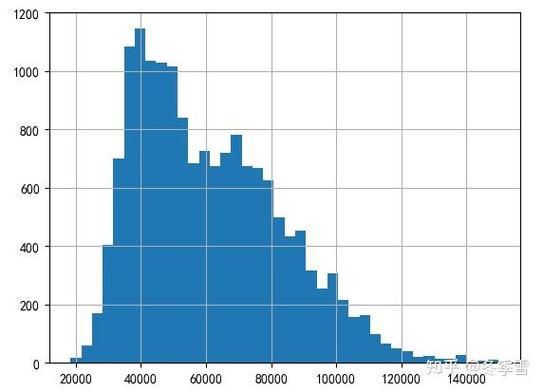
This is a very useful feature for converting numerical data into categorical bins and then counting the occurrences in each bin. This is called binning or discretization.
# Create a Series with numerical data
ages = pd.Series([18, 22, 25, 27, 30, 35, 40, 45, 50, 55])
# Count how many people fall into age groups (bins)
# We'll create 3 bins: 18-30, 31-40, 41-55
age_group_counts = ages.value_counts(bins=3)
print("Age Group Counts:")
print(age_group_counts)
Output:
Age Group Counts:
(17.967, 36.333]    7
(36.333, 54.667]    2
(54.667, 73.0]      1
Name: Age, dtype: int64
Pandas automatically calculated the bin edges. You can also define your own bins:
my_bins = [0, 25, 35, 100]
age_group_counts_custom = ages.value_counts(bins=my_bins)
print("\nCustom Age Group Counts:")
print(age_group_counts_custom)
Output:
Custom Age Group Counts:
(0.0, 25.0]     3
(25.0, 35.0]    3
(35.0, 100.0]   4
Name: Age, dtype: int64
Alternatives (Without Pandas)
While value_counts() is the standard, it's good to know how to do it with Python's built-in tools.
Using collections.Counter
The Counter class from the collections module is designed for exactly this purpose.
from collections import Counter
data = ['Red', 'Blue', 'Red', 'Green', 'Blue', 'Blue', 'Red']
# Counter returns a dictionary-like object
counts = Counter(data)
print(counts)
print(f"Most common: {counts.most_common()}") # .most_common() sorts for you
Output:
Counter({'Blue': 3, 'Red': 3, 'Green': 1})
Most common: [('Blue', 3), ('Red', 3), ('Green', 1)]
Using Pure Python (Dictionary)
You can also achieve this with a simple loop and a dictionary.
data = ['Red', 'Blue', 'Red', 'Green', 'Blue', 'Blue', 'Red']
counts = {}
for item in data:
    counts[item] = counts.get(item, 0) + 1
print(counts)
Output:
{'Red': 3, 'Blue': 3, 'Green': 1}Summary: When to Use What?
| Method | Best For | Pros | Cons |
|---|---|---|---|
pandas.Series.value_counts() |
Data analysis on tabular data (DataFrames/Series). | Extremely fast, integrates with the rest of the Pandas ecosystem, powerful parameters (normalize, bins, dropna), returns a Series which is easy to work with. |
Requires the Pandas library. |
collections.Counter |
Counting items in any iterable (lists, tuples, etc.). | Part of the standard library, very fast, simple and intuitive API (.most_common()). |
Less flexible than Pandas for data analysis tasks (e.g., no direct bins parameter). |
| Pure Python Dictionary | Simple counting or when you can't use external libraries. | No dependencies, great for learning the logic. | More verbose, slower for large datasets, requires manual implementation of sorting. |
For any serious data manipulation in Python, pandas.value_counts() is the undisputed champion and the tool you should be using.