Of course! The phrase "Python web Windows" can mean a few different things, but it generally refers to using Python to build web applications that run on, are developed for, or are deployed to the Windows operating system.
Let's break down the most common interpretations and provide a comprehensive guide.
Developing Web Applications on Windows
This is the most common scenario. You are a Windows user and you want to build a website or web service using Python. The good news is that Python's web ecosystem is cross-platform, so everything works seamlessly on Windows.
Key Tools & Technologies:
-
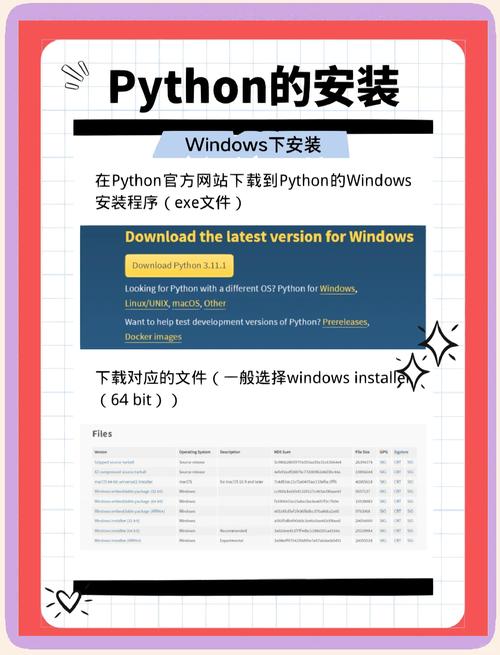
Python Installation: The foundation. Download the latest version from the official Python website. Crucially, during installation, check the box that says "Add Python to PATH". This will make your life much easier.
-
Virtual Environment (
venv): A best practice to keep your project's dependencies isolated. It's built into Python 3. (图片来源网络,侵删)
# Create a virtual environment python -m venv myproject_env # Activate it .\myproject_env\Scripts\activate
-
Web Frameworks: These provide the structure and tools to build your web application.
- Django: A high-level, "batteries-included" framework. Great for complex, database-driven websites with a clear admin panel (e.g., e-commerce, social networks).
- Flask: A lightweight, "micro-framework". Perfect for smaller applications, APIs, or when you want more control over your components.
- FastAPI: A modern, high-performance framework for building APIs. It's incredibly fast, easy to learn, and has automatic interactive documentation.
-
Web Server (WSGI): A server that sits between your web framework and the internet.
- Gunicorn: A popular choice for production. It's a pre-fork worker model, meaning it can handle multiple requests simultaneously.
- Waitress: A pure-Python WSGI server that's simple to use and a great choice for Windows.
-
Package Manager:
pipis the standard for installing Python packages.pip install django flask fastapi gunicorn
Deploying Python Web Applications on Windows
This means your web application is running on a Windows Server. While Linux is more common for web hosting, Windows Server is a robust platform, especially in enterprise environments.
Scenarios for Deployment on Windows:
- IIS (Internet Information Services): This is the built-in web server for Windows Server. You can host Python applications on IIS.
- Azure App Service: Microsoft's cloud platform. You can easily deploy Python web apps (Django, Flask, etc.) to a Windows-based App Service.
- Windows Containers: For modern, scalable deployments, you can package your Python application and its dependencies into a Windows Docker container.
How to Deploy a Python App on IIS (A Common Example):
The process involves a "gateway" that allows IIS (which speaks HTTP) to communicate with your Python application (which speaks WSGI).
-
Install Prerequisites on Windows Server:
- Install Python.
- Install IIS (it's a Windows feature).
- Install the URL Rewrite module for IIS.
- Install a WSGI server. The most common choice is
mod_wsgifor Windows, butWaitressis also a great option.
-
Configure IIS:
- Create a new website in IIS Manager.
- Point the "Physical path" to your application's directory.
- In "Handler Mappings," add a managed handler for your WSGI server (e.g., for
Waitress).
-
The
web.configFile: This is an XML file in your project root that tells IIS how to handle your application. It's the equivalent of an.htaccessfile in Apache.Here's a sample
web.configfor a Flask app usingWaitress:<?xml version="1.0" encoding="utf-8"?> <configuration> <system.webServer> <handlers> <add name="Python FastCGI" path="*" verb="*" modules="FastCgiModule" scriptProcessor="C:\path\to\your\venv\Scripts\python.exe|C:\path\to\your\venv\Lib\site-packages\waitress\run.py" resourceType="Unspecified" requireAccess="Script" /> </handlers> </system.webServer> </configuration>(Note: This is a simplified example. A real deployment might use a more robust setup like
mod_wsgior a reverse proxy like Nginx.)
Building Web Applications for Windows (e.g., a Web UI for a Desktop App)
This is a more specialized use case. You have a desktop application running on Windows, and you want to give it a web-based user interface that can be accessed from a browser on the same machine or the local network.
Common Approach: Use a Framework with a Built-in Server
Frameworks like Flask and FastAPI are perfect for this because they come with a simple development server that you can run easily.
Example: A Simple Flask App for a Windows Tool
Let's say you have a Python script that performs some system task. You can wrap it in a Flask web app.
-
Install Flask:
pip install flask
-
Create
app.py:from flask import Flask, jsonify, request import subprocess import os app = Flask(__name__) # A simple endpoint to get system info @app.route('/api/system_info', methods=['GET']) def get_system_info(): # This is just an example of a system command # Be very careful with user input in real applications! info = { 'current_user': os.getlogin(), 'working_directory': os.getcwd() } return jsonify(info) # An endpoint to run a command (DANGEROUS - for demonstration only) @app.route('/api/run_command', methods=['POST']) def run_command(): data = request.get_json() command = data.get('command') if not command: return jsonify({'error': 'No command provided'}), 400 try: # WARNING: Using os.system or subprocess with user input is a huge security risk. # This is for demonstration only. Never do this in a real app exposed to the internet. output = subprocess.check_output(command, shell=True, stderr=subprocess.STDOUT, text=True) return jsonify({'output': output}) except Exception as e: return jsonify({'error': str(e)}), 500 if __name__ == '__main__': # Runs on http://127.0.0.1:5000 by default # Accessible from other machines on the network if you set host='0.0.0.0' app.run(host='0.0.0.0', port=5000, debug=True) -
Run the App:
python app.py
-
Access the Web UI: Open a web browser on your Windows machine (or another machine on the same network) and go to
http://<your_windows_machine_ip>:5000. You can now interact with your Python logic through a web interface.
Summary Table
| Scenario | Key Technologies on Windows | Best For |
|---|---|---|
| Developing on Windows | Python, venv, VS Code, PyCharm, Django/Flask/FastAPI |
All developers using Windows as their primary machine. |
| Deploying to Windows Server | IIS, web.config, Gunicorn, Waitress, Windows Containers |
Enterprise environments, Azure App Service (Windows). |
| Web UI for a Windows Desktop App | Flask, FastAPI, app.run() |
Creating a management interface for local tools or services. |
Getting Started: A Simple Flask "Hello World" on Windows
-
Open Command Prompt or PowerShell.
-
Create a project folder:
mkdir my_flask_app
cd my_flask_app
-
Create a virtual environment:
python -m venv venv
venv\Scripts\activate
-
Install Flask:
pip install Flask
-
Create
app.py:from flask import Flask app = Flask(__name__) @app.route('/') def hello(): return "Hello, Windows Web World!" if __name__ == '__main__': app.run(debug=True) -
Run the app:
python app.py
-
Open your browser and navigate to
http://127.0.0.1:5000.
You've just created and run a simple web application on Windows