Of course! This is a fundamental and crucial topic in Java development. Let's break down the relationship between UTF-8, Unicode, and how Java handles them.
The Core Concepts: An Analogy
Think of it like this:
- Unicode: This is a giant, universal catalog. It assigns a unique number (a "code point") to every character in every language, including symbols, emojis, and even ancient scripts. For example,
AisU+0041,你isU+4F60, and isU+1F60A. This catalog is the goal—a universal way to represent text. - UTF-8: This is a shipping container or encoding scheme. It's a set of rules for how to pack those Unicode code points into actual bytes for storage or transmission. It's a "variable-width" encoding, meaning it uses 1, 2, 3, or 4 bytes per character depending on the code point. It's the most popular encoding on the web and in modern systems.
Java's Role: Java was designed from the very beginning to be "Unicode-friendly." Its char type was originally intended to hold a single Unicode character. However, the evolution of Unicode revealed a key complexity that Java had to handle.
Unicode in Java: The char Data Type
In Java, the char data type is a 16-bit unsigned integer. It's designed to store a single UTF-16 code unit.
- What is a UTF-16 code unit? UTF-16 is another encoding scheme, like UTF-8, but it's fixed-width (2 bytes per character for the most common characters).
Here's the critical distinction:
- Code Point: A unique number in the Unicode catalog (e.g.,
U+1F60Afor the grinning face emoji). - Code Unit: The 16-bit chunk used by UTF-16 to represent a character.
For the first 65,536 characters in Unicode (the "Basic Multilingual Plane" or BMP), a single char can hold a character perfectly. For example:
char a = 'A'; // The char 'A' is stored as the 16-bit value 0x0041.
The Problem: Supplementary Characters
What about characters outside the BMP, like emojis (, which is U+1F60A) or some rare Chinese/Japanese/Korean characters?
These characters have code points higher than U+FFFF. UTF-16 represents these characters using a surrogate pair: a pair of char values.
- The first
charis the high surrogate. - The second
charis the low surrogate.
Example: The Emoji '😊' (U+1F60A)
- Its code point is
U+1F60A. - In UTF-16, this is represented by the surrogate pair:
- High Surrogate:
U+D83D(decimal:55357) - Low Surrogate:
U+DE0A(decimal:56842)
- High Surrogate:
- In Java, you must use a
Stringto hold this. A singlecharis not enough.
// This is the WRONG way! It will only store the first part of the pair.
// char emoji = '😊'; // This actually works in modern Java due to compiler magic,
                      // but it's stored internally as two chars.
// The correct way to think about it:
String emojiString = "😊";
// How it's stored internally:
// String is an array of char: ['\uD83D', '\uDE0A']
// It takes TWO Java 'char' objects to represent ONE Unicode character.
System.out.println(emojiString.length()); // Output: 2 (because it's an array of 2 char units)
System.out.println(emojiString.codePointCount(0, emojiString.length())); // Output: 1 (the actual number of Unicode characters)
Key Takeaway for char:
- A Java
charholds a 16-bit UTF-16 code unit, not necessarily a full Unicode character. - For characters outside the BMP (like emojis), you need a surrogate pair (two
chars) to represent a single character. - Always use
String.codePointCount()to get the actual number of characters, notString.length().
UTF-8 in Java: The Practical Reality
While Java's internal string representation is UTF-16, UTF-8 is the de-facto standard for I/O (Input/Output): reading from files, writing to the network, reading HTTP requests, etc.
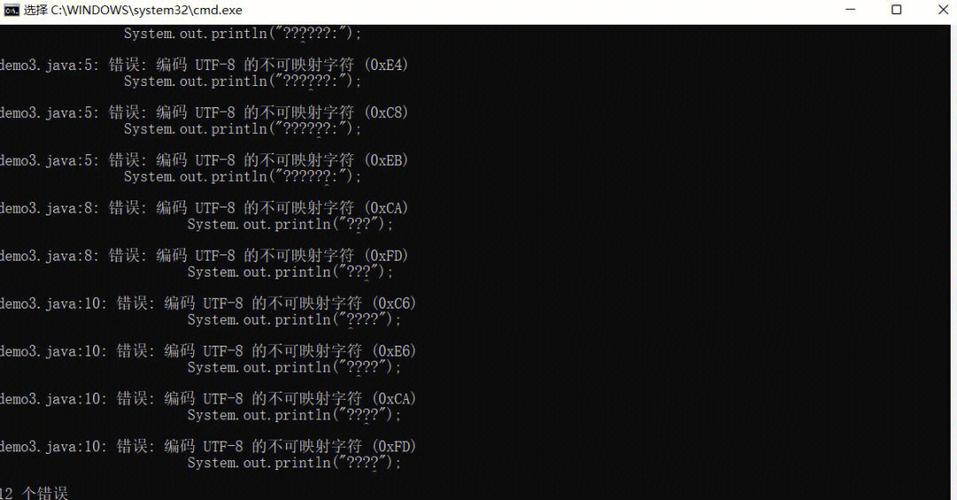
Java provides robust tools to handle UTF-8 seamlessly, but you must configure them correctly. The biggest pitfall is relying on the platform's default encoding.
The Pitfall: Default Charset
If you don't specify an encoding, Java will use the platform's default. This is a major source of bugs.
- On a US Windows machine, it might be
Cp1252. - On a Linux/macOS machine, it's often
UTF-8. - This means code that works on your machine might break on a server or a colleague's machine.
Always specify the encoding explicitly!
Best Practices for UTF-8 in Java
Reading and Writing Files
Use InputStreamReader and OutputStreamWriter and pass StandardCharsets.UTF_8 to them.
import java.io.*;
import java.nio.charset.StandardCharsets;
public class FileExample {
    public static void main(String[] args) {
        String content = "Hello Java! 你好世界! 😊";
        String fileName = "test.txt";
        // --- Writing to a file in UTF-8 ---
        try (BufferedWriter writer = new BufferedWriter(
                new OutputStreamWriter(new FileOutputStream(fileName), StandardCharsets.UTF_8))) {
            writer.write(content);
            System.out.println("File written successfully with UTF-8.");
        } catch (IOException e) {
            e.printStackTrace();
        }
        // --- Reading from a file in UTF-8 ---
        try (BufferedReader reader = new BufferedReader(
                new InputStreamReader(new FileInputStream(fileName), StandardCharsets.UTF_8))) {
            String line;
            while ((line = reader.readLine()) != null) {
                System.out.println("Read from file: " + line);
                System.out.println("Length of string: " + line.length()); // Will be 16
                System.out.println("Number of code points: " + line.codePointCount(0, line.length())); // Will be 13
            }
        } catch (IOException e) {
            e.printStackTrace();
        }
    }
}
Reading from Standard Input (Console)
The Scanner class can take a Charset.
import java.util.Scanner;
import java.nio.charset.StandardCharsets;
public class ScannerExample {
    public static void main(String[] args) {
        System.out.println("Enter some text with accents or emojis:");
        // Use try-with-resources to auto-close the scanner
        try (Scanner scanner = new Scanner(System.in, StandardCharsets.UTF_8.name())) {
            String userInput = scanner.nextLine();
            System.out.println("You entered: " + userInput);
        }
    }
}
Command-Line Arguments
The JVM decodes command-line arguments using the platform's default encoding. To ensure they are UTF-8, you must tell the JVM explicitly when you run the program:
# On Linux/macOS
java -Dfile.encoding=UTF-8 MyProgram "你好世界"
# On Windows (Command Prompt)
chcp 65001
java -Dfile.encoding=UTF-8 MyProgram "你好世界"
Setting the file.encoding system property is the most reliable way to handle arguments, file paths, and standard streams consistently.
Summary Table
| Concept | Description | Java Implementation |
|---|---|---|
| Unicode | A universal character set that assigns a unique number (code point) to every character. | It's the standard Java aims for. The char type was designed based on it. |
| UTF-16 | An encoding scheme that uses 2 bytes per character for most characters. It's Java's internal representation for String and char. |
- String is a sequence of UTF-16 code units.- char is a 16-bit UTF-16 code unit.- Characters outside the BMP (e.g., emojis) are represented by a surrogate pair (two chars). |
| UTF-8 | A variable-width encoding (1-4 bytes per character). It's the standard for I/O (files, network). | - Use InputStreamReader/OutputStreamWriter with StandardCharsets.UTF_8.- Never rely on the default charset. - Set -Dfile.encoding=UTF-8 for consistent command-line and file handling. |
Final Recommendations
- Internal Logic: Trust Java's
Stringandcharhandling. For most application logic, you don't need to worry about the internal UTF-16 representation. Just useStringmethods. - I/O is Key: The most important place to be explicit about encoding is when your code interacts with the outside world (files, network, user input).
- Be Explicit: Always specify
StandardCharsets.UTF_8when reading or writing. Avoid constructors that don't take a charset. - Handle Surrogates: If you are processing text at a low level (e.g., iterating through a
String), use code point methods (codePointAt(),codePointCount(),offsetByCodePoints()) instead ofcharAt()andlength()to correctly handle supplementary characters.