Of course! This is a very common and important concept in Python. The phrase "return for in" isn't a single command, but rather a description of a powerful programming pattern: using a for loop to process a collection and then return a final result from that process.
Let's break it down into two parts:
- The
returnstatement - The
for...inloop - How they work together.
The return Statement
The return statement does two things:
- It immediately exits the function it's in.
- It sends a value back to the code that called the function.
Think of a function as a small, specialized factory. The return statement is the conveyor belt that brings the finished product (the result) out of the factory.
def add_two_numbers(a, b):
  result = a + b
  return result # This sends the value of 'result' back and stops the function
# Calling the function and storing the returned value
sum_result = add_two_numbers(5, 7)
print(sum_result)  # Output: 12
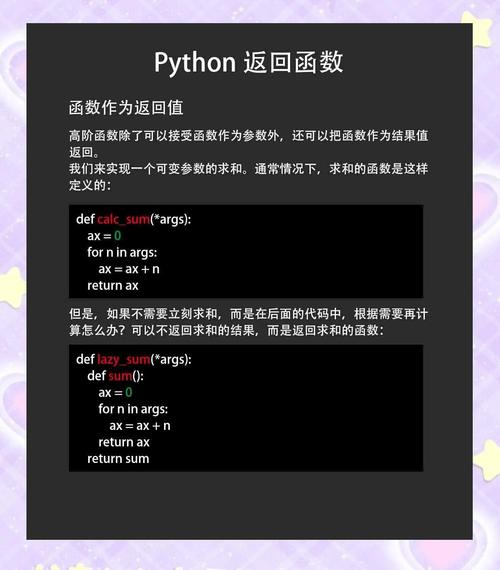
Crucial Point: If a function finishes without a return statement, it automatically returns a special value called None.
def say_hello():
  print("Hello!")
return_value = say_hello()
print(return_value) # Output: None
The for...in Loop
This is the standard way to iterate (or loop) over every item in a collection, like a list, a string, or a range of numbers.
# Loop through a list of fruits
fruits = ["apple", "banana", "cherry"]
for fruit in fruits:
  print(fruit)
# Output:
# apple
# banana
# cherry
# Loop through a string
for letter in "Python":
  print(letter)
# Output:
# P
# y
# t
# h
# o
# n
Combining return and for...in (The Common Patterns)
This is where the real power lies. You typically use a for loop inside a function to gather information or perform calculations, and then you return the final outcome.
Here are the three most common patterns:
Pattern 1: Returning a Single Value After a Loop
You use the loop to find a specific item or calculate a single result, and then you return it. The return statement is usually inside an if condition within the loop.
Example: Finding the first even number in a list.
def find_first_even(numbers):
  """Iterates through a list and returns the first even number found."""
  for number in numbers:
    # Check if the current number is even
    if number % 2 == 0:
      # Found it! Return it immediately and exit the function.
      return number
  # If the loop finishes without finding any even number, return a message.
  return "No even numbers found."
# --- Let's test it ---
my_numbers = [1, 3, 7, 8, 11]
first_even = find_first_even(my_numbers)
print(f"The first even number is: {first_even}") # Output: The first even number is: 8
other_numbers = [1, 3, 5, 7]
no_even = find_first_even(other_numbers)
print(no_even) # Output: No even numbers found.
Key takeaway: The return inside the loop acts like a "mission accomplished" signal, stopping the search immediately.
Pattern 2: Returning a New Collection (e.g., a List)
You use the loop to process each item and build up a new list or other data structure. The return statement is after the loop has finished its work.
Example: Squaring every number in a list.
def square_all(numbers):
  """Squares every number in a list and returns a new list of results."""
  squared_numbers = []  # 1. Create an empty list to store the results
  for number in numbers: # 2. Loop through the original list
    squared_value = number ** 2
    squared_numbers.append(squared_value) # 3. Add the new value to our list
  return squared_numbers # 4. After the loop is done, return the new list
# --- Let's test it ---
original_numbers = [1, 2, 3, 4, 5]
squared_results = square_all(original_numbers)
print(squared_results) # Output: [1, 4, 9, 16, 25]
Key takeaway: The loop does all the work, and the return statement delivers the final, complete collection.
Pattern 3: Returning a Single Accumulated Value (e.g., a Sum or Count)
You use the loop to "accumulate" a total. You initialize a variable (e.g., total = 0) before the loop and update it inside the loop. The return statement is after the loop.
Example: Calculating the sum of a list of numbers.
def calculate_sum(numbers):
  """Calculates the sum of all numbers in a list."""
  total = 0  # 1. Initialize an accumulator variable
  for number in numbers: # 2. Loop through the list
    total = total + number # 3. Add the current number to the total
  return total # 4. After the loop, return the final accumulated total
# --- Let's test it ---
my_scores = [95, 88, 76, 100]
final_sum = calculate_sum(my_scores)
print(f"The total score is: {final_sum}") # Output: The total score is: 359
Summary Table
| Pattern | return Location |
Goal | Example Use Case |
|---|---|---|---|
| Find a Single Item | Inside the loop | Stop searching and return the first item that meets a condition. | Finding the first matching item, a specific value. |
| Build a New Collection | After the loop | Process every item and return a new list/dictionary of results. | Transforming data (e.g., squaring numbers). |
| Accumulate a Single Value | After the loop | Calculate a total (sum, count, product) by updating a variable. | Summing a list, counting occurrences. |