Of course! This is a fundamental concept in Java development, especially in multi-layered applications. Let's break down what Entities and DTOs are, why we need them, and how to use them effectively.
The Core Problem: Why Not Use the Same Object?
Imagine you have a simple User object in your database. It might look like this:
// A class that directly maps to a database table
@Entity
public class User {
    @Id
    @GeneratedValue(strategy = GenerationType.IDENTITY)
    private Long id;
    private String username;
    private String password; // Sensitive!
    private String email;
    private String role; // e.g., "USER", "ADMIN"
    private LocalDateTime createdAt;
    // ... getters and setters
}
Now, consider the following scenarios:
- API Security: You want to send user data to a client (like a web browser or mobile app). Should you send the
passwordandrolefields? Absolutely not! The client doesn't need the password, and exposing the role is a security risk. - API Stability: Your database
Usertable has 15 fields. But your registration API only needs 3:username,email, andpassword. You don't want to create a 15-field object on the client side just to send 3 fields. - Data Transformation: Your database uses snake_case (
first_name), but your API uses camelCase (firstName). You need a way to convert between these formats. - Circular References: Your
Usermight have a list ofPosts, and eachPostmight have a reference back to theUser. If you try to serialize this directly (e.g., to JSON), you'll get an infinite loop and a stack overflow error.
The solution is to use different objects for different contexts. This is where Entities and DTOs come in.
What is an Entity?
An Entity is a Java class that represents a table in your database. It's the core of your persistence layer.
- Purpose: To map objects to database records using a technology like JPA (Java Persistence API) and Hibernate.
- Scope: Lives within your application's backend, typically in your
domainorentitylayer. - Key Characteristics:
- Annotated with
@Entity: Marks it as a JPA entity. - Has an
@Id: Has a primary key, usually annotated with@Idand@GeneratedValue. - Database Mapping: Fields are mapped to database columns (often with
@Column). - Contains Business Logic: Can have business methods (e.g.,
isAdmin()). - Knows about Persistence: It's aware of the database.
- May contain sensitive data: Like passwords, internal status codes, etc.
- Annotated with
Example Entity:
import jakarta.persistence.*;
import java.time.LocalDateTime;
@Entity
@Table(name = "users") // Maps to the "users" table
public class User {
    @Id
    @GeneratedValue(strategy = GenerationType.IDENTITY)
    private Long id;
    @Column(nullable = false, unique = true)
    private String username;
    @Column(nullable = false)
    private String password; // Sensitive data!
    @Column(nullable = false, unique = true)
    private String email;
    @Enumerated(EnumType.STRING)
    private Role role; // e.g., Role.USER, Role.ADMIN
    @Column(name = "created_at", nullable = false)
    private LocalDateTime createdAt;
    // Constructors, Getters, and Setters
    // ...
}
enum Role {
    USER, ADMIN
}
What is a DTO (Data Transfer Object)?
A DTO is a simple, plain Java object (POJO) whose primary purpose is to transfer data between different layers of your application or between your application and an external client.
- Purpose: To define a clean, secure, and tailored data contract for a specific use case.
- Scope: Used in the service layer, controller layer, and for API communication.
- Key Characteristics:
- No Annotations: It has no
@Entity,@Id, or JPA annotations. It's persistence-ignorant. - Flat Structure: Designed for a specific purpose. It might contain only a subset of the entity's fields.
- No Business Logic: Typically just fields, constructors, and getters/setters. It's a data carrier.
- Security: Allows you to expose only the data you want to expose. You can create a
UserCreationDtothat doesn't include theidorrole. - No ORM Mapping: It's not tied to any database table.
- No Annotations: It has no
Example DTOs:
// DTO for creating a new user (no id, no role)
public record UserCreationDto(
    String username,
    String password,
    String email
) {}
// DTO for sending user data to a client (no password, includes role)
public record UserSummaryDto(
    Long id,
    String username,
    String email,
    Role role
) {}
// DTO for updating a user (only fields that can be updated)
public record UserUpdateDto(
    String email
) {}
(Using record is modern and concise for simple DTOs, but a traditional class with getters/setters works just as well).
The Bridge: Converting Between Entities and DTOs
You need a way to convert from an Entity to a DTO and vice versa. There are three common approaches:
a) Manual Mapping (Simple, but error-prone)
public class UserMapper {
    public UserSummaryDto toSummaryDto(User user) {
        if (user == null) {
            return null;
        }
        return new UserSummaryDto(
            user.getId(),
            user.getUsername(),
            user.getEmail(),
            user.getRole()
        );
    }
    public User toEntity(UserCreationDto dto) {
        if (dto == null) {
            return null;
        }
        User user = new User();
        user.setUsername(dto.username());
        user.setPassword(dto.password()); // In a real app, you'd hash this!
        user.setEmail(dto.email());
        return user;
    }
}
b) Using a Mapping Library (Recommended)
Libraries like MapStruct or ModelMapper automate this process. They generate the mapping code at compile time, which is type-safe and highly performant.
Example with MapStruct:
-
Define a Mapper Interface:
import org.mapstruct.Mapper; import org.mapstruct.Mapping; import org.mapstruct.factory.Mappers; @Mapper // MapStruct will generate an implementation of this interface public interface UserMapper { UserMapper INSTANCE = Mappers.getMapper(UserMapper.class); // MapStruct will automatically map fields with the same name. // For fields with different names, use @Mapping. @Mapping(target = "createdAt", ignore = true) // Don't map this field UserSummaryDto userToUserSummaryDto(User user); @Mapping(target = "id", ignore = true) // Don't map the ID on creation @Mapping(target = "createdAt", expression = "java(java.time.LocalDateTime.now())") // Set a value User userCreationDtoToUser(UserCreationDto dto); } -
Use the Mapper in your Service:
@Service
public class UserService {
    @Autowired
    private UserRepository userRepository;
    public UserSummaryDto createUser(UserCreationDto creationDto) {
        User user = UserMapper.INSTANCE.userCreationDtoToUser(creationDto);
        User savedUser = userRepository.save(user);
        return UserMapper.INSTANCE.userToUserSummaryDto(savedUser);
    }
}
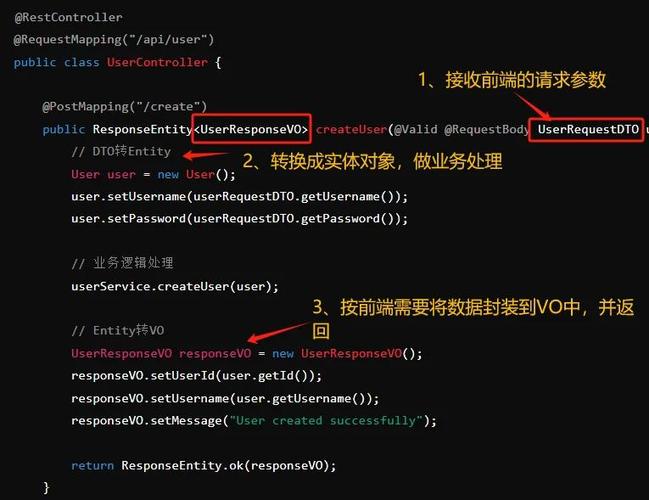
Putting It All Together: A Typical Flow
Here's how these pieces work in a typical web application:
-
Client Request: A client sends a JSON payload to create a user.
{ "username": "johndoe", "password": "securePassword123", "email": "john.doe@example.com" } -
Controller Layer: The
@RestControllerreceives this JSON and Spring deserializes it into aUserCreationDto.@RestController @RequestMapping("/api/users") public class UserController { @Autowired private UserService userService; @PostMapping public ResponseEntity<UserSummaryDto> createUser(@RequestBody UserCreationDto creationDto) { UserSummaryDto createdUser = userService.createUser(creationDto); return new ResponseEntity<>(createdUser, HttpStatus.CREATED); } } -
Service Layer: The
UserServicetakes theUserCreationDto. It uses a mapper (like MapStruct) to convert the DTO into aUserEntity.@Service public class UserService { public UserSummaryDto createUser(UserCreationDto creationDto) { User userEntity = UserMapper.INSTANCE.userCreationDtoToUser(creationDto); // ... hash password, etc. User savedEntity = userRepository.save(userEntity); return UserMapper.INSTANCE.userToUserSummaryDto(savedEntity); } } -
Repository Layer: The
UserRepository(a Spring Data JPA interface) saves theUserentity to the database. -
Response: The service converts the saved
Userentity back into aUserSummaryDto(which excludes the password) and returns it to the controller. The controller then sends this DTO back to the client as a JSON response.
{
  "id": 1,
  "username": "johndoe",
  "email": "john.doe@example.com",
  "role": "USER"
}
Summary Table: Entity vs. DTO
| Feature | Entity | DTO (Data Transfer Object) |
|---|---|---|
| Primary Purpose | Map to a database table. | Transfer data between layers or to a client. |
| Persistence | Yes, it's a persistent object. | No, it's persistence-ignorant. |
| Annotations | @Entity, @Id, @Column, etc. |
None (or custom framework-specific ones). |
| Data Shape | Represents the full database table structure. | Tailored for a specific use case (e.g., create, update, view). |
| Sensitive Data | May contain sensitive data (passwords, roles). | Excludes sensitive data by design. |
| Business Logic | Can contain business logic methods. | Typically a simple data carrier (no logic). |
| Location | Backend (domain/persistence layer). | Service, controller, and API boundary layers. |
| Circular Refs | Can have them (e.g., User -> List |
Designed to avoid them (e.g., UserSummaryDto with a list of PostSummaryDto). |