Of course! Let's dive deep into NumPy slicing. It's a fundamental and powerful feature that allows you to extract portions of arrays, similar to Python's built-in lists, but with much more power and speed for multi-dimensional arrays.

The Core Concept: The start:stop:step Syntax
At its heart, NumPy slicing uses the same syntax as Python lists:
array[start:stop:step]
start: The index where the slice begins (inclusive). If omitted, it defaults to0.stop: The index where the slice ends (exclusive). If omitted, it defaults to the end of the dimension.step: The amount to "jump" between indices. If omitted, it defaults to1.
Slicing 1-Dimensional Arrays
This is the simplest case and works almost exactly like a Python list.
Let's create a 1D array:
import numpy as np
a = np.arange(10) # Creates array([0, 1, 2, 3, 4, 5, 6, 7, 8, 9])
print(f"Original array: {a}\n")
Examples:

-
Get the first 5 elements (from index 0 up to, but not including, 5):
print(a[0:5])   # Output: [0 1 2 3 4]
print(a[:5])    # Output: [0 1 2 3 4]  (start is optional if it's 0)
-
Get elements from index 3 to the end:
print(a[3:]) # Output: [3 4 5 6 7 8 9] (stop is optional to go to the end)
-
Get every other element (using a step of 2):
print(a[::2]) # Output: [0 2 4 6 8]
-
Reverse the array (using a step of -1):
 (图片来源网络,侵删)
print(a[::-1]) # Output: [9 8 7 6 5 4 3 2 1 0]
Slicing Multi-Dimensional Arrays
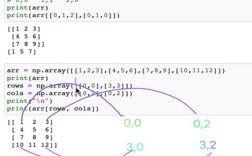
This is where NumPy slicing shines. You apply the start:stop:step syntax to each dimension separately, separated by a comma.
The syntax is: array[dimension1_slice, dimension2_slice, ...]
Let's create a 2D array (a matrix):
import numpy as np
# Create a 3x4 matrix
b = np.arange(12).reshape(3, 4)
print(f"Original 2D array:\n{b}\n")
# [[ 0  1  2  3]
#  [ 4  5  6  7]
#  [ 8  9 10 11]]
Examples:
-
Get the entire first row:
# Slice on the first dimension (rows), get all elements from the first row
# Slice on the second dimension (columns), get all elements
print(b[0, :])
# Output: [0 1 2 3]
-
Get the entire second column:
# Slice on the first dimension, get all rows
# Slice on the second dimension, get the element at index 1
print(b[:, 1])
# Output: [ 1  5  9]
-
Get a sub-matrix (from row 1 to 2, and column 2 to 3):
# Rows: start at index 1, go up to (but not including) index 3. So, rows 1 and 2.
# Columns: start at index 2, go up to (but not including) index 4. So, columns 2 and 3.
print(b[1:3, 2:4])
# Output:
# [[ 6  7]
#  [10 11]]
-
Get every other row and every other column:
# Rows: step of 2 (rows 0 and 2)
# Columns: step of 2 (columns 0 and 2)
print(b[::2, ::2])
# Output:
# [[ 0  2]
#  [ 8 10]]
Slicing Higher-Dimensional Arrays (e.g., 3D)
The logic extends perfectly to 3D or higher dimensions. The comma just separates more slices.
Let's create a 3D array (a "cube" of numbers):
import numpy as np
c = np.arange(24).reshape(2, 3, 4)
print(f"Original 3D array shape: {c.shape}\n")
# Shape is (2, 3, 4), meaning 2 layers, each with 3 rows and 4 columns.
# Layer 0:
# [[ 0  1  2  3]
#  [ 4  5  6  7]
#  [ 8  9 10 11]]
# Layer 1:
# [[12 13 14 15]
#  [16 17 18 19]
#  [20 21 22 23]]
Examples:
-
Get the first layer (index 0):
# Slice on the first dimension (layers), get the first one.
# Get all rows and columns from that layer.
print(c[0, :, :])
# Output is the 3x4 matrix for layer 0 shown above.
-
Get the second row from all layers:
# Get all layers, then the second row (index 1), then all columns.
print(c[:, 1, :])
# Output:
# [[ 4  5  6  7]
#  [16 17 18 19]]
-
Get a single element:
# Layer 1, Row 2, Column 3
print(c[1, 2, 3]) # Output: 23
Important Distinction: Slicing vs. Indexing
This is a critical concept in NumPy.
| Operation | What it Does | Example (b = np.arange(12).reshape(3,4)) |
Result Type | Memory |
|---|---|---|---|---|
| Slicing | Creates a view of the original array. | view = b[1:, 1:] |
numpy.ndarray |
Shared. Changes to the view affect the original. |
| Integer Indexing | Selects specific elements. Can be used to create a copy. | element = b[0, 0] |
Python int or numpy.int64 |
Copied (scalar). |
| Fancy Indexing | Selects a list of indices. Creates a copy. | copy = b[[0, 2], [1, 3]] |
numpy.ndarray |
Copied. |
Example: The "View" vs. "Copy" Behavior
import numpy as np
a = np.arange(10)
print(f"Original array a: {a}")
# Slicing creates a VIEW
view_slice = a[2:6]
print(f"\nView slice (a[2:6]): {view_slice}")
# Modify the view
view_slice[0] = -99
print(f"\nOriginal array a after modifying view: {a}")
print(f"Notice that a[2] also changed! The view shares memory with the original.")
Output:
Original array a: [0 1 2 3 4 5 6 7 8 9]
View slice (a[2:6]): [2 3 4 5]
Original array a after modifying view: [  0   1 -99   3   4   5   6   7   8   9]
Notice that a[2] also changed! The view shares memory with the original.
How to Force a Copy
If you need a new, independent array, you must explicitly create a copy using the .copy() method.
import numpy as np
a = np.arange(10)
print(f"Original array a: {a}")
# Create a COPY of a slice
copy_slice = a[2:6].copy()
print(f"\nCopy slice (a[2:6].copy()): {copy_slice}")
# Modify the copy
copy_slice[0] = -99
print(f"\nOriginal array a after modifying copy: {a}")
print(f"The original array is unchanged. The copy is independent.")
Output:
Original array a: [0 1 2 3 4 5 6 7 8 9]
Copy slice (a[2:6].copy()): [2 3 4 5]
Original array a after modifying copy: [0 1 2 3 4 5 6 7 8 9]
The original array is unchanged. The copy is independent.
Summary Table
| Goal | Syntax | Example |
|---|---|---|
| Slice 1D | arr[start:stop:step] |
arr[1:5:2] |
| Slice all in dim | arr[:, 1] (get all rows, column 1) |
|
| Slice multi-dim | arr[dim1_slice, dim2_slice, ...] |
arr[1:3, ::2] |
| Reverse | arr[::-1] |
arr[::-1, ::-1] |
| Get single element | arr[i, j, k] |
arr[0, 0, 0] |
| Create a copy | arr[...].copy() |
arr[1:, 1:].copy() |