Of course! Let's break down the keyword this in Java. It's a fundamental concept that every Java developer needs to understand.
The Core Idea
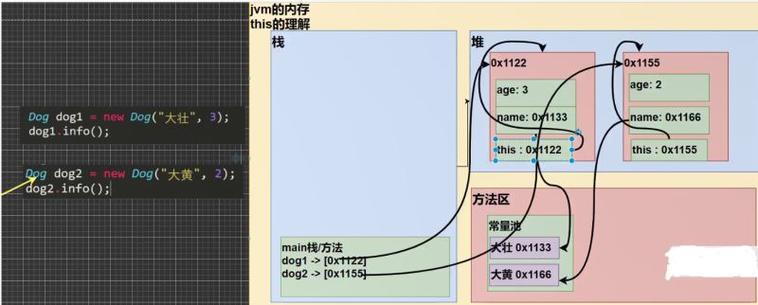
In Java, this is a reference variable that refers to the current object inside an instance method or a constructor.
Think of it as a pronoun, like "I" or "my" in English. When you say "I am building a house," "I" refers to yourself. Similarly, when you use this in a Java method, you are saying "this object's" variable or "this object's" method.
Key Use Cases for this
Here are the most common situations where you need to or should use this.
To Distinguish Between Instance Variables and Parameters
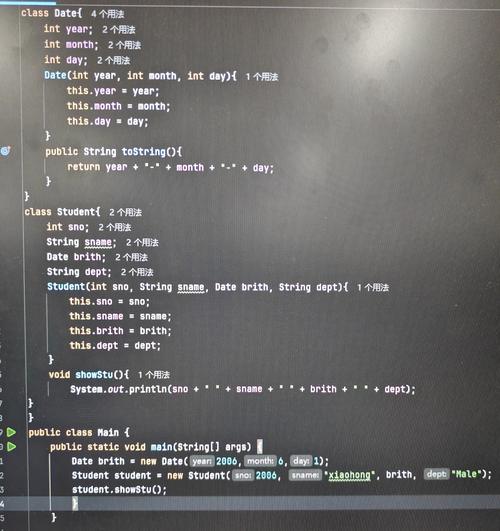
This is the most frequent and important use case. When a method parameter has the same name as an instance variable, Java gets confused. The parameter "shadows" or "hides" the instance variable. this is used to explicitly refer to the instance variable.
Example: A Person class
public class Person {
    // Instance variable
    private String name;
    // Constructor with a parameter 'name'
    public Person(String name) {
        // Here, 'name' on the right refers to the parameter.
        // 'this.name' on the left refers to the instance variable of the class.
        this.name = name;
    }
    public void introduce() {
        System.out.println("Hello, my name is " + this.name);
    }
}
Without this, the code name = name; would be meaningless. It would just be assigning the parameter name to itself, and the instance variable name would remain null. this.name clarifies that you want to assign the value of the parameter to the object's own name field.
To Invoke Current Class Methods
You can use this to explicitly call a method from within another method in the same class. While it's often optional (as Java assumes you're calling the method on the current object), it can make the code clearer.
public class Calculator {
    public int add(int a, int b) {
        System.out.println("Adding " + a + " and " + b);
        return a + b;
    }
    public int calculateSum(int a, int b) {
        // Using 'this' to call the 'add' method
        int sum = this.add(a, b);
        System.out.println("The sum is: " + sum);
        return sum;
    }
}
To Invoke Current Class Constructor (Constructor Chaining)
You can use this() to call one constructor from another constructor within the same class. This is called constructor chaining and helps avoid code duplication.
Rules for this():
- It must be the first statement in the constructor.
- You can only have one
this()call in a constructor.
Example: A Student class
public class Student {
    private String name;
    private int id;
    // Constructor 1: Takes only a name
    public Student(String name) {
        // 'this()' calls the other constructor that takes name and id
        this(name, 0); // Default ID to 0 if not provided
        System.out.println("Student with name created.");
    }
    // Constructor 2: Takes name and id
    public Student(String name, int id) {
        this.name = name; // Using 'this' to distinguish
        this.id = id;
        System.out.println("Student with name and ID created.");
    }
    @Override
    public String toString() {
        return "Student [Name=" + this.name + ", ID=" + this.id + "]";
    }
}
To Pass the Current Object as an Argument
You can pass the current object to another method or constructor. This is common when you want a method in another class to have access to the full state of the current object.
public class Car {
    private String model;
    public Car(String model) {
        this.model = model;
    }
    // This method takes another Car object as an argument
    public void compareWith(Car otherCar) {
        System.out.println("Comparing my model (" + this.model + ") with " + otherCar.model);
    }
}
// In the main method:
Car myCar = new Car("Tesla Model S");
Car friendsCar = new Car("Ford Mustang");
myCar.compareWith(friendsCar); // 'this' inside compareWith will refer to 'myCar'
To Return the Current Object
You can use this to return the current object from a method. This is a common pattern in Builder Design Patterns, allowing for method chaining.
Example: A StringBuilder-like class
class PersonBuilder {
    private String name;
    private int age;
    public PersonBuilder setName(String name) {
        this.name = name;
        // Return 'this' to allow chaining
        return this;
    }
    public PersonBuilder setAge(int age) {
        this.age = age;
        // Return 'this' to allow chaining
        return this;
    }
    public Person build() {
        return new Person(name, age);
    }
}
// Usage:
Person p = new PersonBuilder()
              .setName("Alice")
              .setAge(30)
              .build();
What this is NOT
It's equally important to understand where this cannot be used.
-
In a
staticContext:staticmethods and variables belong to the class, not to any specific object. Sincethisrefers to a current object, it cannot be used inside a static method or static initializer block. Using it will result in a compile-time error.public class MyClass { static int staticVar; public static void myStaticMethod() { // COMPILE ERROR: 'this' cannot be used in a static context // this.staticVar = 10; } } -
To Refer to
staticMembers: You should not usethisto access a static variable or method. It's redundant and considered bad practice. Just use the class name directly.public class MyClass { static int staticVar; public void instanceMethod() { // Correct way MyClass.staticVar = 20; // Works, but is confusing and not recommended // this.staticVar = 20; } }
Summary Table
| Use Case | Example Code | Why Use It? |
|---|---|---|
| Disambiguate Variables | this.name = name; |
To assign a method parameter to the class's instance variable when they have the same name. |
| Invoke Current Method | this.calculateSum(a, b); |
To explicitly call another method in the same class, improving readability. |
| Invoke Current Constructor | this(name, 0); |
For constructor chaining to avoid code duplication. Must be the first statement. |
| Pass Current Object as Argument | someMethod(this); |
To allow another method to operate on or have access to the entire current object. |
| Return Current Object | return this; |
To enable method chaining, common in Builder patterns and fluent APIs. |
| ❌ In Static Context | static void myMethod() { this.x = 5; } // Error |
static members belong to the class, not an instance, so there is no this object to refer to. |
| ❌ For Static Members | this.staticVar = 10; // Avoid |
Redundant and confusing. Static members should be accessed via the class name (e.g., MyClass.staticVar). |