Of course! The term "super object" in Python almost always refers to the built-in super() function. It's a fundamental tool for inheritance, allowing you to call methods from a parent class.
Let's break it down in detail.
What is super()?
At its core, super() is a built-in function that returns a proxy object (a "super object"). This proxy object lets you access methods and properties of a parent or sibling class. It's most commonly used inside a subclass to call a method from the class it inherited from.
The main goal is to avoid explicitly naming the parent class, which makes your code more maintainable and flexible.
The Problem super() Solves: Inheritance
When you create a child class, it inherits all the methods and properties from its parent class. Often, you want to extend the parent's method, not completely replace it.
Example without super():
Imagine you have an Animal class and a Dog class. The Dog wants to have its own __init__ method but also needs to run the Animal's __init__ to set up the name attribute.
class Animal:
    def __init__(self, name):
        print("Animal's __init__ called")
        self.name = name
class Dog(Animal):
    def __init__(self, name, breed):
        print("Dog's __init__ called")
        # Manually calling the parent's __init__
        Animal.__init__(self, name)
        self.breed = breed
# Let's create a Dog instance
my_dog = Dog("Rex", "German Shepherd")
print(f"Name: {my_dog.name}")
print(f"Breed: {my_dog.breed}")
Output:
Dog's __init__ called
Animal's __init__ called
Name: Rex
Breed: German Shepherd
This works, but it's not ideal. What if the Animal class is renamed? You'd have to find and replace every Animal.__init__ call in all its subclasses. This is brittle and hard to maintain.
The Solution: Using super()
Now, let's rewrite the same example using super().
class Animal:
    def __init__(self, name):
        print("Animal's __init__ called")
        self.name = name
class Dog(Animal):
    def __init__(self, name, breed):
        print("Dog's __init__ called")
        # Use super() to call the parent's __init__
        super().__init__(name)
        self.breed = breed
# Let's create a Dog instance
my_dog = Dog("Rex", "German Shepherd")
print(f"Name: {my_dog.name}")
print(f"Breed: {my_dog.breed}")
Output:
Dog's __init__ called
Animal's __init__ called
Name: Rex
Breed: German Shepherd
This does the exact same thing, but it's much better because:
- No Hardcoding: We don't need to write
Animal.__init__(...). If we change the parent class ofDog, we don't need to change this line. - Readability:
super()clearly communicates our intent: "I want to call the method from the next class in the Method Resolution Order (MRO)."
How super() Works: The Method Resolution Order (MRO)
Python uses a specific order to find which method to call when you use super(). This order is called the Method Resolution Order (MRO).
You can see the MRO of a class by calling the __mro__ attribute.
class Animal:
    pass
class Dog(Animal):
    pass
class Bulldog(Dog):
    pass
print(Bulldog.__mro__)
Output:
(<class '__main__.Bulldog'>, <class '__main__.Dog'>, <class '__main__.Animal'>, <class 'object'>)This output shows that when you call a method on a Bulldog instance, Python will look for it in this order:
Bulldogitself.- If not found, look in
Dog. - If not found, look in
Animal. - If still not found, look in the base
objectclass.
When you use super(), you are telling Python: "Start looking for the method after the current class in the MRO."
Let's see a more complex example:
class A:
    def do_something(self):
        print("Doing something in A")
class B(A):
    def do_something(self):
        print("Doing something in B")
        super().do_something() # Call the next class in the MRO
class C(A):
    def do_something(self):
        print("Doing something in C")
        super().do_something() # Call the next class in the MRO
class D(B, C):
    def do_something(self):
        print("Doing something in D")
        super().do_something() # Call the next class in the MRO
# Let's see the MRO for D
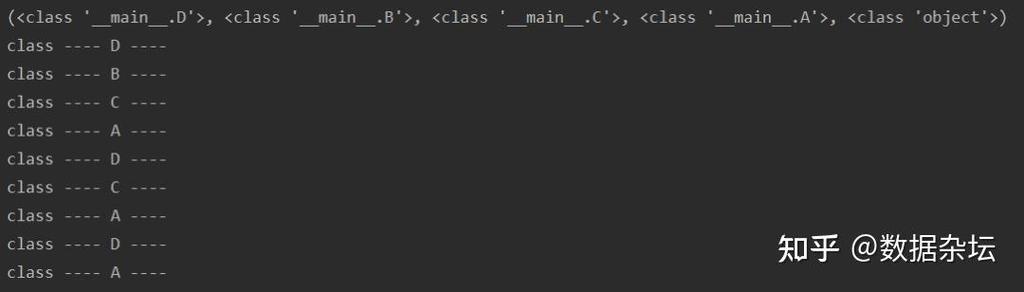
print(D.__mro__)
# Output: (<class '__main__.D'>, <class '__main__.B'>, <class '__main__.C'>, <class '__main__.A'>, <class 'object'>)
# Now let's create an instance of D and call the method
d_instance = D()
d_instance.do_something()
Output:
(<class '__main__.D'>, <class '__main__.B'>, <class '__main__.C'>, <class '__main__.A'>, <class 'object'>)
Doing something in D
Doing something in B
Doing something in C
Doing something in A
Notice the chain: D calls super(), which finds B. B calls super(), which finds C. C calls super(), which finds A. This is the power of super() in a multiple inheritance scenario.
Common Use Cases
Calling Parent __init__ (Most Common)
As shown before, this is the primary use case for setting up an object's state.
class Vehicle:
    def __init__(self, brand):
        self.brand = brand
class Car(Vehicle):
    def __init__(self, brand, model):
        super().__init__(brand)  # Initialize the parent part
        self.model = model       # Initialize the child part
Extending Parent Methods
You can add new behavior before or after calling the parent's method.
class FileHandler:
    def read(self):
        print("Reading from a generic file...")
class CsvFileHandler(FileHandler):
    def read(self):
        # Add custom behavior before the parent's behavior
        print("Preparing to read a CSV file...")
        # Call the parent's read method
        super().read()
        # Add custom behavior after the parent's behavior
        print("CSV data parsed successfully.")
csv_handler = CsvFileHandler()
csv_handler.read()
Output:
Preparing to read a CSV file...
Reading from a generic file...
CSV data parsed successfully.
Cooperative Multiple Inheritance
This is the most advanced use case, where multiple parent classes are designed to work together using super(). Each class in the inheritance chain does its part and then passes control to the next class in the MRO.
class Base:
    def __init__(self):
        print("Base.__init__")
class A(Base):
    def __init__(self):
        print("A.__init__")
        super().__init__()
class B(Base):
    def __init__(self):
        print("B.__init__")
        super().__init__()
class C(A, B):
    def __init__(self):
        print("C.__init__")
        super().__init__()
print(C.__mro__)
c = C()
Output:
(<class '__main__.C'>, <class '__main__.A'>, <class '__main__.B'>, <class '__main__.Base'>, <class 'object'>)
C.__init__
A.__init__
B.__init__
Base.__init__
Key Takeaways
super()is a function, not a keyword. It returns a proxy object.- Its main purpose is to call methods from a parent class in a way that is safe for multiple inheritance.
- It avoids hardcoding parent class names, making your code more maintainable.
- It respects the Method Resolution Order (MRO), which is the specific path Python takes to find methods in an inheritance hierarchy.
- It is most famously used to call the parent class's
__init__method from within a child class's__init__.