Of course! Let's break down that line of Python code.
The code is:
print(“”_)
Quick Answer
When you run this code in a standard Python interpreter, you will get a SyntaxError.
Detailed Explanation
The SyntaxError
The error occurs because of the _" part at the end. In Python, an underscore _ by itself is a valid identifier (a valid variable name). However, when you place it immediately after a string literal (), Python's parser gets confused.
It sees the string and then the token _. It doesn't know how to interpret the combination ""_. It's not a valid operation, so it raises a SyntaxError.
A Note on Smart Quotes
The quotes you used, , are "smart quotes" or "curly quotes" used in word processors. While some modern code editors might be smart enough to handle them, standard Python requires straight quotes ( or ).
It's best practice to always use straight quotes in your code to avoid potential issues. The correct version of your code would be:
print("")_
Even with straight quotes, you will still get the SyntaxError for the reason explained above.
What You Might Have Meant
It's very likely that you intended to do one of a few common things. Here are the possibilities and how to fix them.
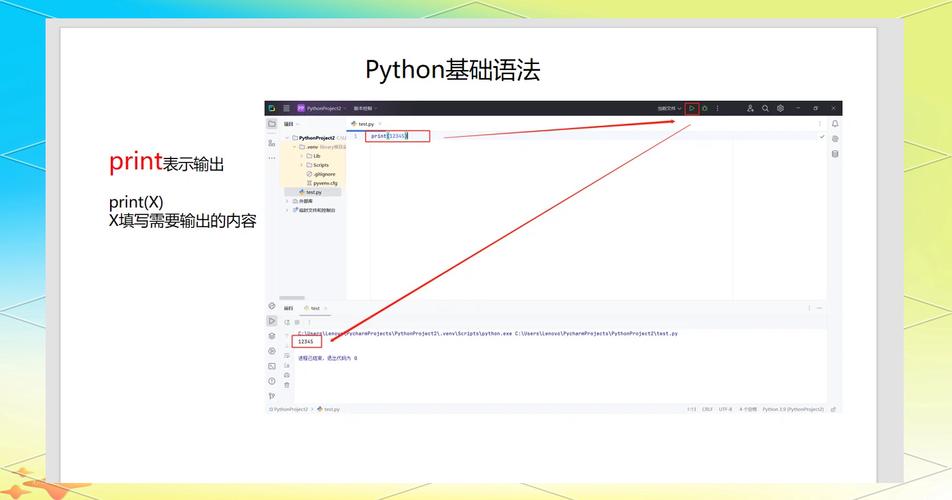
Possibility 1: You wanted to print an empty string.
If you just wanted to print a blank line, you should only put the empty string inside the print() function.
Correct Code:
print("")
Output:
(Nothing will be printed to the console, but a blank line will be created in the output stream, like when you hit Enter in a text editor.)
Possibility 2: You wanted to print an underscore.
If you wanted to print the character _, you should put it inside the quotes.
Correct Code:
print("_")
Output:
_Possibility 3: You wanted to print a string and then an underscore.
If you wanted to concatenate (join) an empty string and an underscore, you need to use the operator.
Correct Code:
print("" + "_")
Output:
_This works because "" + "_" evaluates to the string "_" before being passed to the print() function.
Possibility 4: You were experimenting with the "last expression" feature in an interactive interpreter.
In an interactive Python shell (like the one you get by just typing python in your terminal), if you type an expression on a line by itself, Python will "print" its representation for you. The underscore _ is a special variable that holds the last result.
However, ""_ is still not a valid expression on its own. If you wanted to see the representation of an empty string, you would just type the string:
Example in an interactive shell:
>>> ""
''
>>> _
''
In this case, typing and pressing Enter prints (Python's representation of an empty string). The _ variable then holds that value, and typing _ and pressing Enter shows you its value.
Summary
| Your Code | The Problem | The Fix | What it Does |
|---|---|---|---|
print(“”_) |
SyntaxError from invalid ""_ syntax. |
print("") |
Prints a blank line. |
print(“”_) |
Uses "smart quotes" which can cause errors. | print("") |
Prints a blank line. |
print(“”_) |
Likely a typo. | print("_") |
Prints the single character _. |
print(“”_) |
Attempted concatenation without an operator. | print("" + "_") |
Prints the single character _. |