Of course! Let's dive deep into Math.random() in Java. It's a fundamental method for generating random numbers, but it's important to understand how it works and what its limitations are.
The Basics: What is Math.random()?
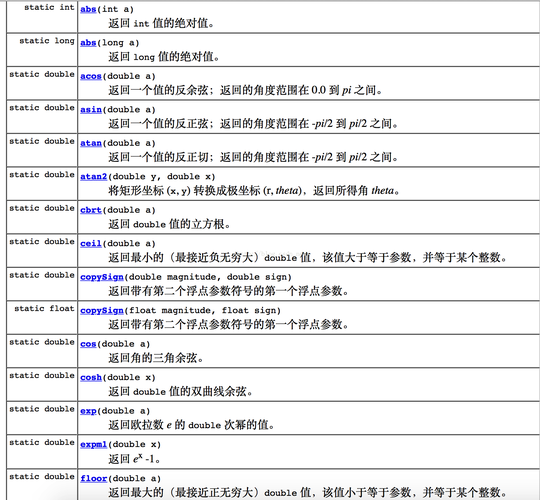
Math.random() is a static method in Java's java.lang.Math class. It returns a double value.
- Return Type:
double - Value Range: A
doublevalue greater than or equal to0and less than0(i.e.,[0.0, 1.0)). - Distribution: The values are pseudorandom and follow a uniform distribution. This means every number in the range has an equal chance of being chosen.
Example:
public class RandomExample {
    public static void main(String[] args) {
        // Generate a random double between 0.0 (inclusive) and 1.0 (exclusive)
        double randomValue = Math.random();
        System.out.println("Random double: " + randomValue);
        // Example output:
        // Random double: 0.7318948312345678
    }
}
How to Generate Random Numbers in a Specific Range
The real power of Math.random() comes from using it to generate numbers within a specific range you need. The most common use case is for integers.
Formula for Integers
To get a random integer between a min (inclusive) and max (inclusive) value, you use the following formula:
(int)(Math.random() * (max - min + 1)) + min
Let's break down why this works:
Math.random(): Generates a number from0to999....max - min + 1: Calculates the total number of possible integers in your desired range.- Example: For
min=5andmax=10, the range is5, 6, 7, 8, 9, 10. That's10 - 5 + 1 = 6numbers.
- Example: For
Math.random() * (max - min + 1): Scales the random number. Now you have a range from0up to (but not including)0in our example.(int) ...: Casts the result to an integer. This truncates the decimal part, effectively "rounding down". So, you get an integer from0to5.+ min: Shifts the range. If you add5to the numbers0-5, you get your final range of5to10.
Practical Examples
Example 1: Random Integer in a Range (e.g., 1 to 10)
This is a classic example, like rolling a 10-sided die.
public class DiceRoll {
    public static void main(String[] args) {
        int min = 1;
        int max = 10;
        // Generate a random number between 1 and 10
        int diceRoll = (int)(Math.random() * (max - min + 1)) + min;
        System.out.println("You rolled a: " + diceRoll);
    }
}
Example 2: Random Integer from a List (e.g., Choosing a Random Name)
This is a very common pattern. You generate a random index and use it to pick an element from an array or ArrayList.
import java.util.ArrayList;
import java.util.List;
public class RandomPicker {
    public static void main(String[] args) {
        List<String> names = new ArrayList<>();
        names.add("Alice");
        names.add("Bob");
        names.add("Charlie");
        names.add("Diana");
        names.add("Ethan");
        // The size of the list is 5. Valid indices are 0, 1, 2, 3, 4.
        // min = 0, max = 4
        int randomIndex = (int)(Math.random() * names.size());
        String winner = names.get(randomIndex);
        System.out.println("The randomly selected winner is: " + winner);
    }
}
Example 3: Random Double in a Range (e.g., 0.0 to 10.0)
The process is similar but simpler because you don't need to worry about casting to an integer or adding a + 1.
public class RandomDoubleRange {
    public static void main(String[] args) {
        double min = 0.0;
        double max = 10.0;
        // Generate a random double between 0.0 (inclusive) and 10.0 (exclusive)
        double randomDouble = Math.random() * (max - min) + min;
        System.out.println("Random double: " + randomDouble);
    }
}
Math.random() vs. java.util.Random
For serious applications, Math.random() is generally not the recommended tool. The modern, more flexible, and more powerful way to generate random numbers is by using the java.util.Random class.
| Feature | Math.random() |
java.util.Random |
|---|---|---|
| Type | Static method (Math.random()) |
Class instance (new Random()) |
| Seed | Uses a single, internal, static seed. Not configurable. | Uses a system time-based seed by default, but can be set explicitly. |
| Flexibility | Only generates doubles in [0.0, 1.0). |
Provides methods for all primitive types: nextInt(), nextLong(), nextBoolean(), nextDouble(), etc. |
| Performance | Can be slower as it creates a new Random object internally on each call. |
More efficient, as you create one instance and reuse it. |
| Thread Safety | Thread-safe. Each call is independent. | Not thread-safe. If multiple threads use the same Random instance, it can lead to contention and incorrect results. Use ThreadLocalRandom for multi-threaded apps. |
When to use which?
- Use
Math.random()for: Quick, simple, one-off scripts, or when you just need a single random number and don't care about seeding or performance. - Use
java.util.Randomfor: Any real application, especially if you need different types of random numbers (ints, longs, booleans), want to control the seed for reproducibility, or care about performance.
Example with java.util.Random:
import java.util.Random;
public class RandomClassExample {
    public static void main(String[] args) {
        // Create a single instance of Random
        Random rand = new Random();
        // Generate a random integer between 1 and 10 (inclusive)
        int diceRoll = rand.nextInt(10) + 1; // nextInt(10) gives 0-9
        // Generate a random boolean (true or false)
        boolean coinFlip = rand.nextBoolean();
        // Generate a random double between 0.0 and 1.0 (same as Math.random())
        double randomDouble = rand.nextDouble();
        System.out.println("Dice Roll: " + diceRoll);
        System.out.println("Coin Flip: " + coinFlip);
        System.out.println("Random Double: " + randomDouble);
    }
}
The Modern Choice: java.util.concurrent.ThreadLocalRandom
Since Java 7, the best practice for generating random numbers in multi-threaded applications is ThreadLocalRandom. It's a variant of Random that avoids contention between threads, offering better performance.
import java.util.concurrent.ThreadLocalRandom;
public class ThreadLocalRandomExample {
    public static void main(String[] args) {
        // Get the thread-local random instance
        // No need to create a new one!
        // Generate a random int between 1 and 10 (inclusive)
        int diceRoll = ThreadLocalRandom.current().nextInt(1, 11); // bound is exclusive
        System.out.println("Dice Roll: " + diceRoll);
    }
}
Summary
| Method | Best For | Key Takeaway |
|---|---|---|
Math.random() |
Quick, simple scripts. | Easy to use for a single double, but inflexible. |
java.util.Random |
General-purpose, single-threaded apps. | The classic, flexible choice for most scenarios. |
ThreadLocalRandom |
Multi-threaded applications. | The modern, high-performance standard for concurrent code. |